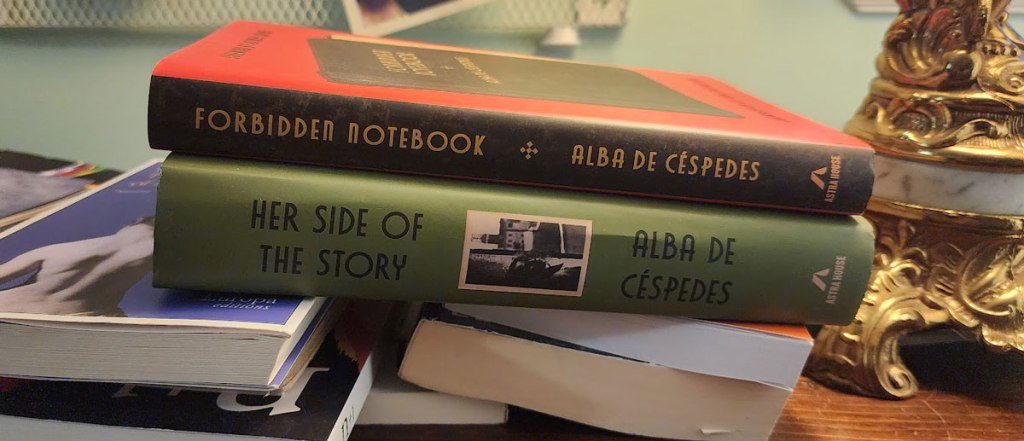
After finishing all of Elena Ferrante’s novels last year, I started looking into who some of her inspirations were because I wanted more. So far, this has led me to Alba de Cespedes and Elsa Morante (and Simone de Beauvoir, but I’ve already read a couple of her books). I saw that two of Alba’s books had been translated to English from Italian last year, so I started with those, and finished reading Forbidden Notebook and Her Side of the Story recently. Both are about housewives who are dissatisfied in their marriages and lives, but with very different endings. I haven’t read too much about her life yet aside from her Wikipedia page and an article about her in the Guardian, but what I do know is she spent time in prison and on the run from fascists during World War II for “antifascist activities”, like writing and having a radio show in protest of the government. Her distaste for marriage makes sense, as she got married at 15 and was divorced by 20. She also had an advice column in a newspaper, which I would love to read because I think an Italian post-war advice column for women would be fascinating. The column was titled Dalla Parte Di Lei, which was also the title of Her Side of the Story in Italian, and translates to “on her side”.
I read Her Side of the Story first, which begins right before WWII and ends soon after Italy and Germany surrendered. The main character, Alessandra, starts by telling us about her mother’s suicide. As a piano teacher, her mother meets a young man who she falls in love with named Hervey. She threatens to leave her husband for her student, but Alessandra’s father says he will take everything from her and ruin her life if she does. Despite this, Alessandra encourages her mother to run away with her true love. Her mother drives her car into a river and drowns. Alessandra is then sent to live with extended family in the country, and doesn’t see her father for a while.
In the country, she mostly focuses on her studies, but eventually her family tries to arrange a marriage for her. She refuses to marry because she is not in love, and she wants to experience something like her mother’s love for Hervey. She returns to Rome to stay with her aging father and attend college. During this time, the war starts, and her friend Claudio gets drafted and later captured as a prisoner of war. Aside from that, she doesn’t have much awareness of the war or the politics surrounding it, and continues her studies and caring for her father. Then, she meets Francesco.
Francesco is a professor, and Alessandra falls in love with him quickly. They spend time meeting at cafes and walking around Rome together. He confesses a dangerous secret to her – he is an antifascist, and has to keep this information hidden to keep them both safe. Alessandra knows that it’s dangerous for her to be with him, but doesn’t care. Soon, they decide to get married, but Alessandra’s passion and love for him ends up leaving her disappointed immediately after getting married to him. She agonizes over feeling unloved and underappreciated, and tries to explain to him that the countless hours she spends cooking, and cleaning, all on top of working, she does it all for him, but he doesn’t even seem to enjoy spending time with her or talking to her anymore. He gives her excuse after excuse as to why he is too busy to bother with her needs, and she tries to accept his reasoning out of love for him.
Francesco has to go into hiding, and tasks his friend with checking on and helping Alessandra. His friend makes romantic advances toward Alessandra, but she resists. She also aids Francesco’s antifascist friends in delivering bombs by hiding them among vegetables and carrying them on her bicycle. When the war ends, Francesco returns home and invites his friends over to the house to Alessandra’s disappointment, because after being away from her for so long, she wants his undivided attention. She continues to feel neglected by him, even after expressing that she just wants him to show that he cares for her, and winds up shooting him in the back while he is sleeping. The book ends with a trial that finds her guilty of murder.
In Forbidden Notebook, Valeria is a mother of two young adult children who still live at home with their parents, but are both in relationships and likely to soon move out of the house. She buys a notebook at the store, and has to hide it from her family to ensure that she can keep writing in it. She laments her role as a wife and mother, expressing dismay at having to revolve her entire existence around other people. Because she no longer has to care for young children though, she decides to start working to earn some money. Meanwhile, her husband works on and finally finishes writing a script for a movie, which he then tries to pitch to a friend of Valeria’s who works at a film studio. Her friend tells Valeria that the studio would not be picking up the script, which is about a married man with an exciting secret life where he is cheating on his wife. She is a little suspicious of her husband’s friendship with this woman, but takes the rejection of his script as a sign that nothing was going on between them.
Valeria kind of revels in his failure, and around this time also gradually becomes more and more flirtatious with her boss. The two of them run into each other at the office on the weekend, both using extra work as an excuse to get away from their families. Valeria’s family stress primarily comes from her children; her daughter has been discretely seeing a married man, and her son has been courting a girl that Valeria sees as dull and unintelligent, unworthy of marrying her son. One of my favorite parts of the book is a conversation between Valeria and her daughter, where her daughter explains that although the man she has been dating is married, him and his wife have been separated a long time, and there is nothing wrong with the relationship because though they’re still married, they aren’t really together anymore. Valeria sees her daughter as having no morals or respect for marriage, and it’s true that her daughter doesn’t care about marriage at all. This is all going on of course while Valeria’s own affair with her boss continues to intensify.
She plans to go on a vacation with her boss, and tells her family that she needs a break from all the demands of her life at home and at work. They all support her in getting away for awhile (without knowing of the affair), until her son confesses that his girlfriend is pregnant and they need to get married as soon as possible, with the wedding date coinciding with her vacation. She cancels the trip, and her boss tries to convince her that they should reschedule, but she decides that instead she is going to end the affair and burn her diary all right before her son’s wedding.
My favorite quote from Forbidden Notebook is from a moment when her and her husband have a disagreement, and she writes:
“Often, faced with men’s bad moods, I wonder what they would do if instead of only their office job they had, like every woman, so many different problems to confront and solve.”
What I like about these books is how focused they are on women’s daily lives, but in doing so, they reveal so much about women’s position in the home and society. It’s interesting to me too how both of them are housewives who also work outside the home, and it highlights how much is expected of them in their personal lives in addition to work. Neither of their husbands take on any additional responsibility to alleviate their wife’s burdens, and expect her to continue doing everything for everyone.
 Alex Powelson